About Us: Purpose and Mission
Not sure who the NCCPA is and what we do? What does the NCCPA credential mean? Check out the following video on NCCPA! It goes through the nuts and bolts of how and why NCCPA was established and the purpose of the credential. After watching the video, read more on the history of NCCPA below.
It's better in HD! If you have broadband internet connection, click here.
NCCPA's Purpose, Vision and Mission
NCCPA is the only certifying organization for physician assistants in the United States. Established as a not-for-profit organization in 1975, NCCPA is dedicated to assuring the public that certified physician assistants meet established standards of clinical knowledge and cognitive skills upon entry into practice and throughout their careers. All U.S. states, the District of Columbia and the U.S. territories have decided to rely on NCCPA certification as one of the criteria for licensure or regulation of physician assistants. More than 100,000 physician assistants have been certified by NCCPA since 1975, and more than 90,000 are certified today.
Our Vision Statement
Transform the delivery of quality healthcare by certifying qualified PAs through programs that improve patient care while exemplifying a commitment to excellence unparalleled among certifying organizations.
Our Mission Statement
To serve the public through exemplary programs that evaluate critical PA competencies and that require the pursuit of life-long learning and improvement.
A Brief History
In the 1960s, during the wake of a large number of military corpsmen re-entering the civilian population, Eugene Stead, then chairman of the Department of Medicine at Duke University, recognized the need for a midlevel health practitioner, whose function would be of a generalist, primary care nature. He intended this midlevel health practitioner to complement the services and skills of physicians, often times in more remote areas and areas of high need. Collaboration was taking place among organized physician groups, educators, the United States government, and medical regulatory bodies in establishing a foundation for the components of the needed physician assistant profession.
In 1965, four ex-Navy corpsmen were enrolled in the first physician assistant program - a two-year, intensive, generalist-model program at Duke University. Following this lead, training programs began to proliferate in the United States - many supported by grants from federal and private foundations.
With the increase in the number of PA training programs came a need to develop a program evaluation mechanism. In 1971, the American Medical Association (AMA) Committee on Allied Health Education and Accreditation (CAHEA) developed training program guidelines and implemented a program accreditation mechanism, in an effort to maintain consistency throughout PA programs. Simultaneously, the recognition of a need for an agency to represent the professional interests evolved, and the American Academy of Physician Assistants (AAPA) was established. Soon after, the Association of Physician Assistant Programs, APAP, (now the Physician Assistant Education Association) was formed to provide a forum for the exchange of information between educators.
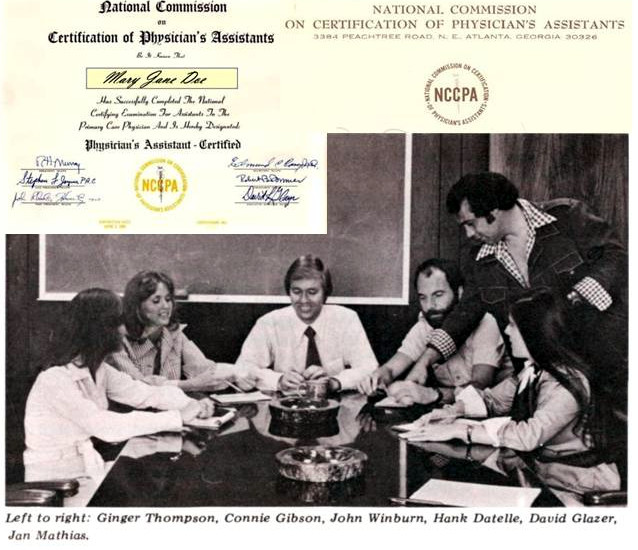
In 1972, the National Board of Medical Examiners (NBME) and the AMA convened representatives from fourteen different organizations, including the AAPA and PAEA, to discuss the need for establishing an independent certifying authority for the physician assistant profession. Three years later, the National Commission on Certification of Physician Assistants (NCCPA) was formed to fulfill that role.
NCCPA is the only nationally recognized certifying body for physician assistants in the United States. Established as a not-for-profit organization in 1975, NCCPA is dedicated to assuring the public that certified physician assistants meet professional standards of clinical knowledge and cognitive skills. All U.S. states, the District of Columbia and the U.S. territories have decided to rely on NCCPA certification criteria for initial licensure or regulation of physician assistants.
To attain certification, PAs must graduate from an accredited PA program and pass the Physician Assistant National Certifying Exam (PANCE). PANCE is a multiple-choice test that comprises 300 questions that assess basic medical and surgical knowledge.
After passing PANCE, PAs become NCCPA-certified, which entitles them to use the Physician Assistant-Certified® (PA-C®) designation until the expiration of their first cycle (approximately two years). To maintain NCCPA certification and retain the right to use the PA-C designation beyond the expiration of their initial certification, they must follow a multifaceted process, involving documentation of continuing medical education (CME) credits every two years and successful completion of a recertification exam in the fifth or sixth year of a six-year certification maintenance cycle.
As the physician assistant profession continues to evolve and grow, so does NCCPA and the certification process. In the last decade, NCCPA has taken several steps to shore up the integrity of the certification process, including the institution of CME audits, assumption of all CME logging duties for PAs maintaining certification, streamlining the CME deadlines and logging process in the certification expiration year, requiring new graduates to become certified within six years or six attempts at PANCE and enacting a more comprehensive disciplinary policy, including the establishment of a Code of Conduct for Certified and Certifying PAs. Simultaneously, NCCPA has become a more service-driven organization that now boasts a fully interactive Web site, high satisfaction ratings among PAs and quick response times for those using NCCPA services.
In 2003, NCCPA initiated a cross-organizational effort to establish a profession-wide definition of PA competencies now used as a map for professional development and evaluation throughout a PA's career.
In 2007, NCCPA received the Georgia Oglethorpe Award for performance excellence and was the first non-profit organization and the first organization with a health care focus to receive this distinguished recognition. The Georgia Oglethorpe Board of Examiners said of NCCPA, "Commitment to customer satisfaction is pervasive and systematic through the organizational processes. In this manner, the organization can meet and exceed its goal of being responsive, innovative and effective in addressing the interest of the public and other stakeholders."
Also, NCCPA has earned accreditation from the National Commission for Certifying Agencies (NCCA). The NCCA is the accrediting arm of the Institute for Credentialing Excellence (ICE). Established in 1977 as a nonprofit organization, ICE is a leader in setting quality standards for certifying organizations.

Imbued with a strong sense of responsibility to assure that PAs meet professional standards of knowledge and skills, NCCPA will continue to strive to meet the needs of its stakeholders efficiently, effectively and honorably.

PA Sign In